
We all leave traces of ourselves in the world: the clothes we wear, our automobiles and house fixtures, the books we read and pass along, the materials we create and transform. Material culture explores how everyday items -clothes, tools, furniture, technology – reflect the social and cultural frameworks we live in. These books reveal the hidden stories of objects and invite us to think about our material world in a new light. Curated by Ashley Lewis.
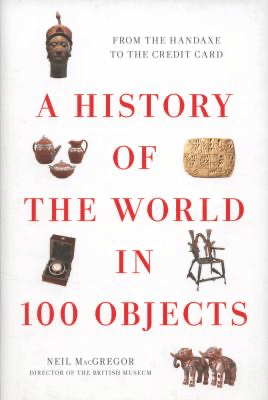
A History of the World in 100 Objects by Neil MacGregor
When did people first start to wear jewelry or play music? When were cows domesticated and why do we feed their milk to our children? Where were the first cities and what made them succeed? Who invented math or came up with money?
The history of humanity is a history of invention and innovation, as we have continually created new items to use, to admire, or to leave our mark on the world. In this original and thought-provoking book, Neil MacGregor, director of the British Museum, has selected one hundred man-made artifacts, each of which gives us an intimate glimpse of an unexpected turning point in human civilization. A History of the World in 100 Objects stretches back two million years and covers the globe. From the very firsthand axe to the ubiquitous credit card, each item has a story to tell; together they relate the larger history of mankind-revealing who we are by looking at what we have made.
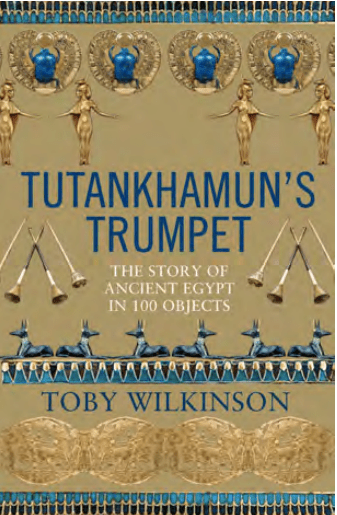
Tutankhamen’s Trumpet by Tony Wilkinson
On 26 November 1922 Howard Carter first peered into the newly opened tomb of an ancient Egyptian boy-king. When asked if he could see anything, he replied: ‘Yes, yes, wonderful things.’
In Tutankhamun’s Trumpet, acclaimed Egyptologist Toby Wilkinson takes a unique approach to a well-worn subject. Instead of concentrating on the oft-told story of the discovery or speculating on the (brief) life and (fractious) times of the boy-king, Wilkinson takes the objects buried with the king as the source material for a wide-ranging, detailed portrait of ancient Egypt – its geography, history, culture and legacy. One hundred artefacts from the tomb, arranged in ten thematic groups, are allowed to speak again – not only for themselves, but as witnesses of the civilization that created them. Never have the treasures of Tutankhamun been analyzed and presented for what they can tell us about ancient Egyptian culture, its extraordinary development, its remarkable flourishing, and its lasting impact. Like Tutankhamun himself, the music which surrounded him has vanished. All that remains are echoes of the past, survivors of an age long gone, the stuff of interpretation and reinterpretation. But through the objects buried with him, his world, and the civilization of ancient Egypt of which he remains the ultimate symbol, can be brought back to life.
Filled with surprising insights, unusual details, vivid descriptions and, above all, remarkable objects, Tutankhamun’s Trumpet will appeal to all lovers of history, archaeology, art and culture, as well as all those fascinated by the Egypt of the pharaohs.
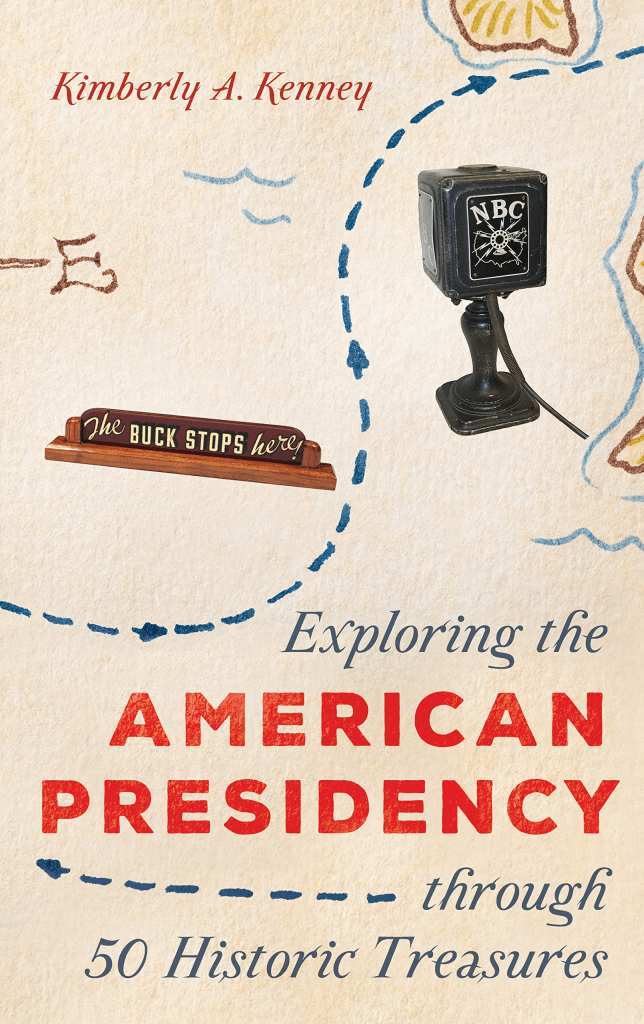
Exploring the American Presidency Through 50 Historic Treasures by Kimberly Kenney
No person in the world is more recognizable than an American president. These men are larger than life, and as the leader of the free world they had the opportunity to shape history in ways that most of us cannot imagine. Some objects, such as the Resolute desk, Air Force One, or the presidential seal, are symbolic of the position itself, but each president has at least one artifact that largely defines his life and his presidency. For example, George Washington’s ill-fitting dentures plagued him for most of his life, affecting the very image of his face that we have all come to recognize. Millions of Americans were comforted by Franklin D. Roosevelt’s “fireside chats” as he spoke into a radio microphone during the Great Depression and World War II. John F. Kennedy memorialized a coconut husk, with a message he wrote after his PT boat was destroyed in the Pacific Ocean, into a paperweight he kept on his desk in the Oval Office. Bill Clinton appeared on late night television playing the saxophone to appeal to younger voters.
Exploring the American Presidency through 50 Historic Treasures brings together significant artifacts from the lives of the men who have led our nation through times of great prosperity and terrible tragedy. When we look at our presidents through the lens of the material culture they left behind, it humanizes them and creates relevance to our own lives. This book features full-color images of 50 artifacts that were chosen by the very people who work at presidential sites and historical museums, stewarding the legacies of our presidents.
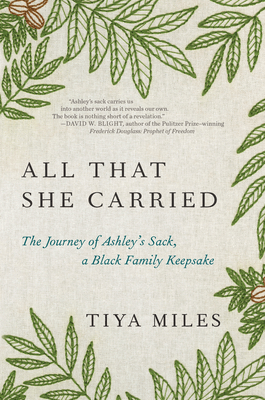
All That She Carried by Tiya Miles
In 1850s South Carolina, an enslaved woman named Rose faced a crisis: the imminent sale of her daughter Ashley. Thinking quickly, she packed a cotton bag for her with a few items, and, soon after, the nine-year-old girl was separated from her mother and sold. Decades later, Ashley’s granddaughter Ruth embroidered this family history on the sack in spare, haunting language.
Historian Tiya Miles carefully traces these women’s faint presence in archival records, and, where archives fall short, she turns to objects, art, and the environment to write a singular history of the experience of slavery, and the uncertain freedom afterward, in the United States. All That She Carried is a poignant story of resilience and love passed down against steep odds. It honors the creativity and resourcefulness of people who preserved family ties when official systems refused to do so, and it serves as a visionary illustration of how to reconstruct and recount their stories today.
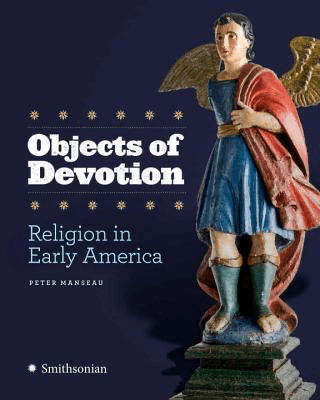
Objects of Devotion by Peter Manseau
Objects of Devotion: Religion in Early America tells the story of religion in the United States through the material culture of diverse spiritual pursuits in the nation’s colonial period and the early republic. The beautiful, full-color companion volume to a Smithsonian National Museum of American History exhibition, the book explores the wide range of religious traditions vying for adherents, acceptance, and a prominent place in the public square from the 1630s to the 1840s. The original thirteen states were home to approximately three thousand churches and more than a dozen Christian denominations, including Anglicans, Baptists, Catholics, Congregationalists, Lutherans, Methodists, Presbyterians, and Quakers. A variety of other faiths also could be found, including Judaism, Islam, traditional African practices, and Native American beliefs. As a result, America became known throughout the world as a place where, in theory, if not always in practice, all are free to believe and worship as they choose. The featured objects include an 1814 Revere and Sons church bell from Salem, the Jefferson Bible, wampum beads, a 1654 Torah scroll brought to the New World, the only known religious text written by an enslaved African Muslim, and other revelatory artifacts. Together these treasures illustrate how religious ideas have shaped the country and how the treatment and practice of religion have changed over time. Objects of Devotion emphasizes how religion can be understood through the objects, both rare and every day, around which Americans of every generation have organized their communities and built this nation.

The Quilts of Gee’s Bend by Susan Rubin
Since the early 19th century, the women of Gee’s Bend in southern Alabama have created stunning, vibrant quilts. Award-winning author Susan Goldman Rubin’s The Quilts of Gee’s Bend explores the history and culture of this fascinating group of women and their unique quilting traditions, using meticulous research to offer an exclusive look at an important facet of African American art and culture.
In the rural community of Gee’s Bend, African American women have been making quilts for generations. They use scraps of old overalls, aprons, and bleached cornmeal sacks—anything they can find. Their traditions have been passed down through the decades. Much to the women’s surprise, a selection of the quilts was featured in an exhibition at the Museum of Fine Arts, Houston, in 2002. The exhibition then traveled to the Whitney Museum in New York City. “Eye-poppingly gorgeous,” wrote a critic for the New York Times about the exhibition. He continued, “Some of the most miraculous works of modern art America has produced.”
Rubin is known for producing well-researched, highly praised, and sophisticated biographies of artists and other important figures. Through similar research, The Quilts of Gee’s Bend shares specifics about this rare community and its rich traditions, allowing children to pause to consider history through the eyes of the people who lived it and through a legacy that is passed on to the next generation.
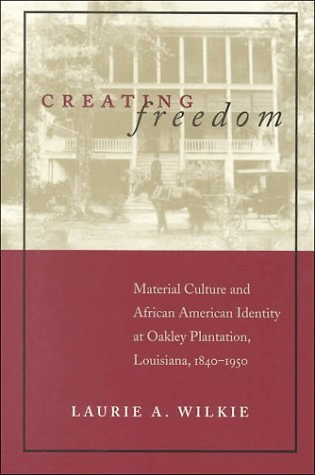
Creating Freedom by Laurie Wilkie
Historians’ conception of plantation life in the American South, both post- and antebellum, derives almost exclusively from the written record, hence mainly from the white owners’ perspectives. In Creating Freedom, historical archaeologist Laurie Wilkie pulls the half-opened curtain wider by seeking out the experiences of the majority of people who made their home on plantations: the African American laborers. Specifically, Wilkie examines the lives of four black families who lived at Oakley Plantation in south Louisiana’s West Feliciana Parish over the course of one hundred years. Using an innovative blend of archaeological evidence and oral interviews, as well as written documents, she builds a composite of their daily existence that is at once riveting and humanizing in its detail and invaluable in its broader applications.
Creating Freedom is in part Wilkie’s attempt to understand how African Americans at Oakley Plantation, and by extension most southern blacks, endured the violence and oppression of slavery, Reconstruction, and Jim Crow. It is through their material culture, enhanced by a range of other data, that she describes the complex but uplifting process by which they retained their ties to a cultural past while renegotiating their identity as free persons.
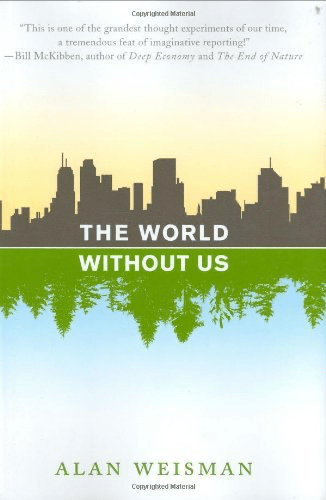
The World Without Us by Alan Weisman
In The World Without Us, Alan Weisman offers an utterly original approach to questions of humanity’s impact on the planet: he asks us to envision our Earth, without us. In this far-reaching narrative, Weisman explains how our massive infrastructure would collapse and finally vanish without human presence; which everyday items may become immortalized as fossils; how copper pipes and wiring would be crushed into mere seams of reddish rock; why some of our earliest buildings might be the last architecture left; and how plastic, bronze sculpture, radio waves, and some man-made molecules may be our most lasting gifts to the universe.
The World Without Us reveals how, just days after humans disappear, floods in New York’s subways would start eroding the city’s foundations, and how, as the world’s cities crumble, asphalt jungles would give way to real ones. It describes the distinct ways that organic and chemically treated farms would revert to the wild, how billions more birds would flourish, and how cockroaches in unheated cities would perish without us. Drawing on the expertise of engineers, atmospheric scientists, art conservators, zoologists, oil refiners, marine biologists, astrophysicists, religious leaders from rabbis to the Dalai Lama, and paleontologists—who describe a prehuman world inhabited by megafauna like giant sloths that stood taller than mammoths—Weisman illustrates what the planet might be like today, if not for us.
From places already devoid of humans (a last fragment of primeval European forest; the Korean DMZ; Chernobyl), Weisman reveals Earth’s tremendous capacity for self-healing. As he shows which human devastations are indelible, and which examples of our highest art and culture would endure longest, Weisman’s narrative ultimately drives toward a radical but persuasive solution that needn’t depend on our demise. It is narrative nonfiction at its finest, and in posing an irresistible concept with both gravity and a highly readable touch, it looks deeply at our effects on the planet in a way that no other book has.
 Shelf Analysis