
Look close and see that the world around us changes ceaselessly, and new avenues of observation, analysis, and meditation spring up and engage our minds and hearts.
These new offerings in the world of nature writing are in turns poetic and plain, sweeping and granular, turning careful gaze on all those creatures we adore, those we detest, and those we ignore, in all the strange places that creatures call home: the whole wide ocean, boiling chemical pools, the open sky, our own dainty eyelashes. Curated by Ashley Lewis.
Looking for digital? Check for eBooks and eAudiobooks here.
cloudLibrary | Libby | Freading
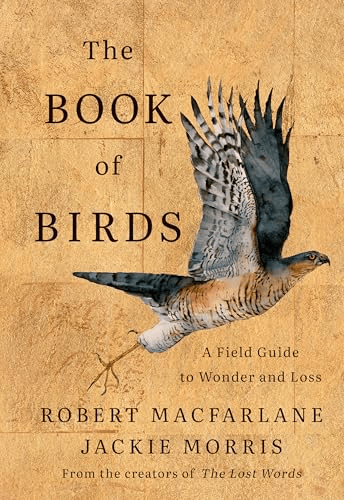
The Book of Birds by Robert Macfarlane and Jackie Morris
The Book of Birds is a field guide with a difference: It shows readers not just how to identify birds, but also how to identify with them. Robert Macfarlane and Jackie Morris conjure the unique spirit of nearly fifty once-common species: avocet to yellowhammer, kestrel to kingfisher, skylark to nightingale. In lyrical and incantatory essays, Macfarlane describes each bird’s habits and habitats, their patterns of flight and patterns of song, how they hunt or fish or scavenge or gather, how they nest and raise their chicks, the myths that attend them, the threats that shadow them—and how their lives intersect with our own. On every page we encounter Morris’s exhilarating artwork, painted from life in watercolor and gold leaf, and animated with an extraordinary attention to detail. The Book of Birds is a love letter to the thrilling variety and mysteries of birdlife, and a clarion call to halt the rapid depletion of our skies.
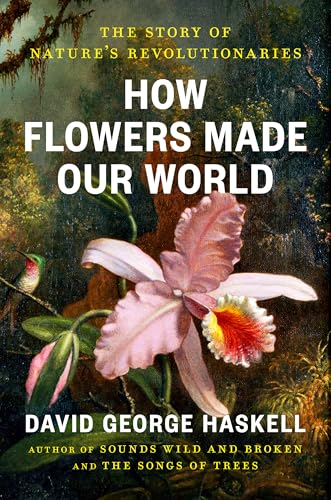
How Flowers Made Our World by David George Haskell
We live on a floral planet, yet flowers don’t get the credit they deserve. We admire them for their aesthetics, not their world-changing power. Inspired by the most up-to-date scientific research, David George Haskell observes, smells, and studies flowers such as magnolias, orchids, and roses, as well as fascinating but less well-known flowers such as seagrasses, to show us what we’ve been missing.
Flowers are beautiful revolutionaries. When they evolved, they remade the natural They used beauty to transform former enemies into cooperative partners. They reinvented plant growth, sex, and motherhood. Through radical genetic flexibility, they turned past environmental upheavals into opportunities for renewal. This inventiveness allowed them to build and sustain rain forests, savannahs, prairies, and even ocean shores.
Without flowers, human beings would not exist. We are a floral species, dependent on flowers for food and our habitats, as well as using flowers for beauty, scent, and culturally important rituals. Looking to the future, flowers offer us lessons on resilience and creativity in the face of rapid environmental change. How Flowers Made Our World combines lyrical writing, sensual exploration, and scientific expertise to explore some of the most consequential life forms ever to have evolved, showing how our planet came to be and how it thrives today.
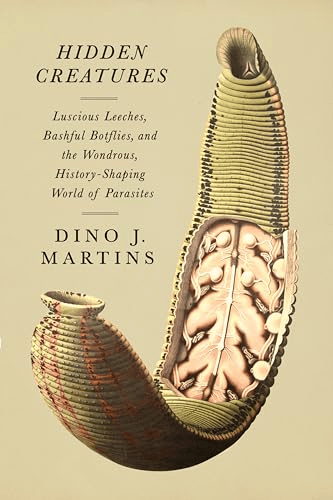
Hidden Creatures by Dino Martins
There is the tapeworm, which can grow 120 feet in length within the gut of a whale; the tsetse fly, a notorious vector of disease that can pierce the skin even of crocodiles with its needle-like mouth; and the most universal symbol of parasitic the leech. Long villainized as, well, parasitic, these creatures are actually a vital part of every ecosystem—and Dr. Dino Martins, an award-winning entomologist and biologist from Kenya, has made it his life’s mission to demystify these beguiling beings.
Hidden Creatures is a journey around the world ten times over—from Martins’ home in the wilds of East Africa, to the rainforests of the Amazon, to cities and backyards across the globe—and along the way, we encounter the brilliant and eccentric experts who join Martins on his adventures to investigate not only parasites but their hosts, from hyraxes and hippos to, of course, humans. Immersive, driven by an utterly infectious curiosity, and sure to transform every reader’s understanding of these organisms, Hidden Creatures has the magnetic force of a David Attenborough documentary and introduces a monumental, charismatic new voice in science writing.
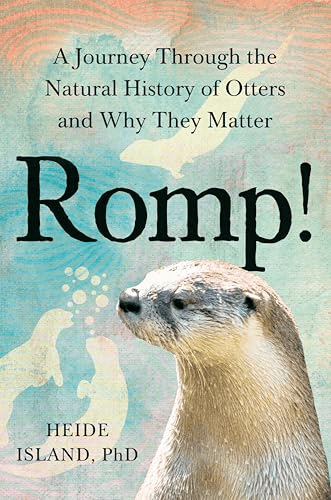
Romp! By Heide Island
You’ve heard of a murder of crows and a pride of lions—but what about a romp of otters? In this informative and entertaining book, animal behaviorist Heide Island takes readers on an odyssey through otterdom, focusing on a family, or “romp,” of river otters that live near her home in Puget Sound while also weaving in research about otters around the globe. Tracking an otter nicknamed Patches and her three pups, Island observes as they hunt, play, and try to survive the various dangers in their environment.
But the greatest danger they face isn’t predators or food-stealing scavengers. It’s humans. Because while they captivate our imagination with their intelligent and social behavior, these charming creatures, like so many species, face an uncertain future in an era of climate change and habitat destruction. And we can learn crucial lessons about nature and our relationship with it by studying their adaptability, diversity, and personality, from the adorable sea otters of Monterey Bay to the giant otters of the Amazon.
Discover what otters have to teach us about the world we share in Romp!
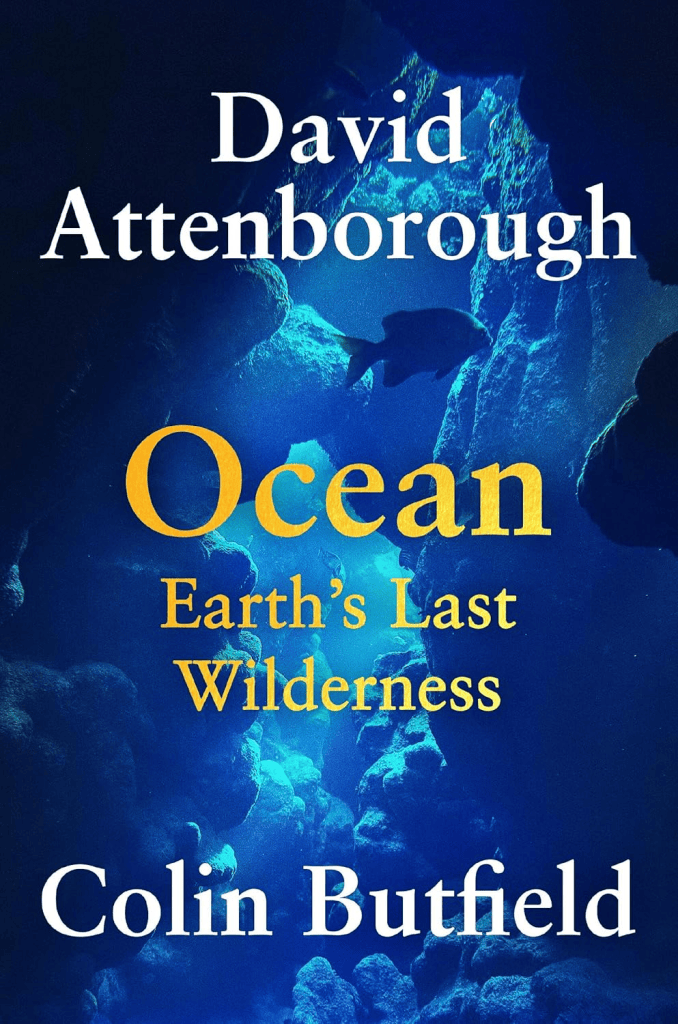
Ocean by David Attenborough and Colin Butfield
Through personal stories, history and cutting-edge science, Ocean uncovers the mystery, the wonder and the frailty of the most unexplored habitat on our planet – and the one which shapes the land we live on, regulates our climate and creates the air we breathe. The book showcase the oceans’ remarkable resilience: they are the part of our world that can, and in some cases has, recovered the fastest, if we only give them the chance.
Drawing a course across David Attenborough’s own lifetime, Ocean takes readers on an adventure-laden voyage through eight unique ocean habitats, through countless intriguing species, and through the most astounding discoveries of the last 100 years, to a future vision of a fully restored marine world, even richer and more spectacular than we could possibly hope. Ocean reveals the past, present and potential future of our blue planet. It is a book almost a century in the making, but one that has never been more urgently needed.
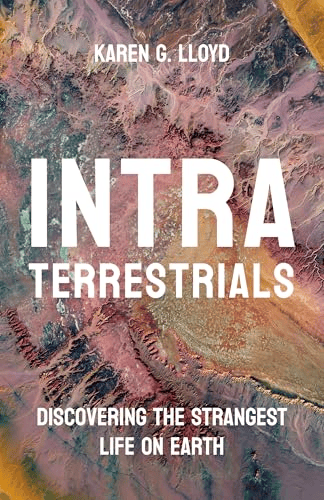
Intraterrestrials by Karen G. Lloyd
Life thrives in the deepest, darkest recesses of Earth’s crust—from methane seeps in the ocean floor to the highest reaches of Arctic permafrost—and it is unlike anything seen on the surface. Intraterrestrials shares what scientists are learning about these strange types of microbial life—and how research expeditions to some of the most extreme locales on the planet are broadening our understanding of what life is and how its earliest forms may have evolved.
Drawing on her experiences and those of her fellow scientists working in challenging and often dangerous conditions, Karen Lloyd takes readers on an adventure from the bottom of the ocean in submersibles through the jungles of Central America to the high-altitude volcanoes of the Andes. Only discovered in recent decades, “intraterrestrials”—subsurface beings that are truly alien—are demonstrating how life can exist in boiling water, pure acid, and bleach. They enable us to peer back to the very dawn of life on Earth, disclosing deep branches on the tree of life that push the limits of what we thought possible. Some can “breathe” rocks or even electrons. Others may live for hundreds of thousands of years or longer. All of them are living in ways that are totally foreign to us surface dwellers.
Blending captivating storytelling with the latest science, Intraterrestrials reveals what microbes in Earth’s deep surface biosphere can tell us about the prospects for finding life on other planets—and the future of life on our own.
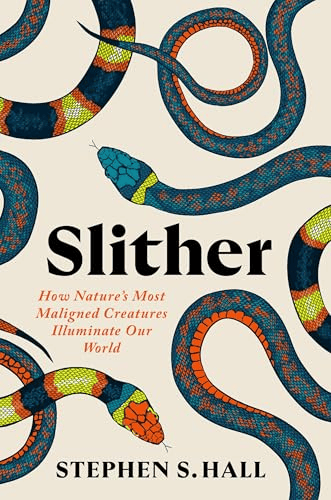
Slither by Stephen S. Hall
A spellbinding scientific and cultural study of snakes, the fascination and fear they inspire, and how surprising new science is indelibly changing our perception of these stunning and frightening creatures.
For millennia, depictions of snakes as alternatively beautiful and menacing creatures have appeared in religious texts, mythology, poetry, and beyond. From the foundational deities of ancient Egypt to the reactions of squeamish schoolchildren today, it is a historically commonplace belief that snakes are devious, dangerous, and even evil. But where there is hatred and fear, there is also fascination and reverence. How is it that creatures so despised and sinister, so foreign of movement and ostensibly devoid of sociality and emotion, have fired the imaginations of poets, prophets, and painters across time and cultures?
In Slither, science writer Stephen S. Hall presents a naturalistic, cultural, ecological, and scientific meditation on these loathed yet magnetic creatures. In each chapter, he explores a biological aspect of The Snake, such as their cold blooded metabolism and venomous nature, alongside their mythology, artistic depictions, and cultural veneration. In doing so, he explores not only what neurologically triggers our wary fascination with these limbless creatures, but also how the current generation of snake scientists is using cutting-edge technologies to discover new truths about these evolutionarily ancient creatures—truths that may ultimately affect and enhance human health.

